
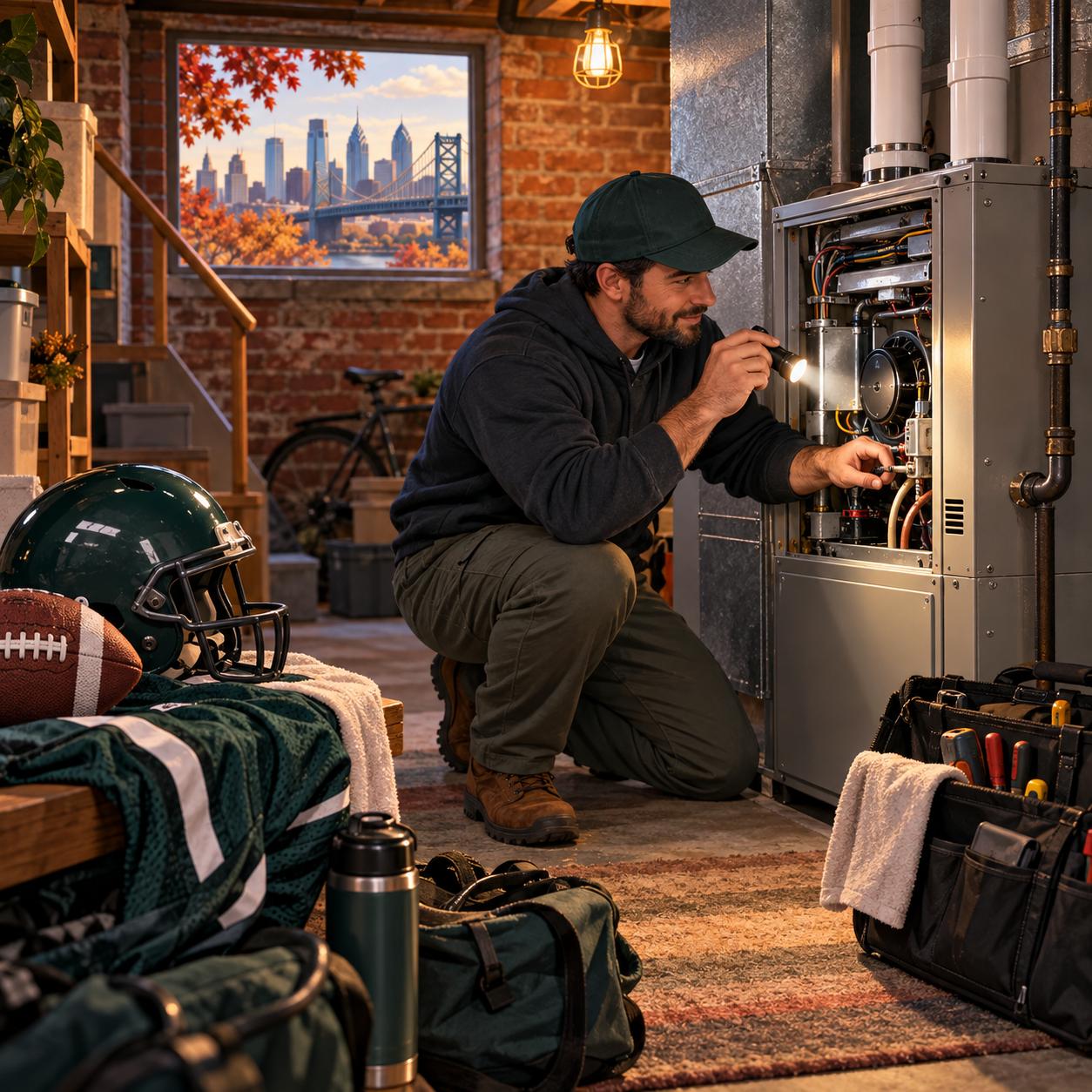
The Birds have found ways to win, beating Washington 24–22 and Tennessee 24–20. That's what good teams do — they figure out how to close out games even when things aren't clicking.
But there are warning signs underneath the 2-0 record: injuries are piling up, the running game hasn't found its rhythm, and turnovers and negative plays are making each game harder than it needs to be. On paper, the record looks great. Underneath it, there's work to do.
Philadelphia homeowners should look at their heating systems the same way.
Your Furnace Might Be "Winning" Too
Your furnace, boiler, or heat pump may turn on today when you flip the thermostat — but that doesn't necessarily mean it's ready for a full Philadelphia winter. A system that fires up fine on a mild 55-degree evening in September can behave very differently on a 15-degree night in January, when it has to run longer, harder, and more often.
Small problems stay hidden the same way the Eagles' negative plays get papered over by a game-winning drive. A slightly dirty flame sensor, a weak capacitor, a clogged filter, low refrigerant, a cracked heat exchanger — none of these show up as "the system won't turn on." They show up as reduced efficiency, uneven heat, higher bills, and — eventually, usually on the coldest night of the year — a full breakdown.
The Warning Signs Worth Watching
Injuries piling up — for a heating system, that's strange smells, unusual noises, short cycling, or a pilot light/igniter that struggles to stay lit. Small mechanical issues that get worse under load.
The running game hasn't found rhythm — uneven heating room to room, a thermostat that reads one temperature while the house feels like another, or a system that runs constantly but never quite catches up. That's your system working overtime to compensate for something that isn't right.
Turnovers and negative plays — rising energy bills without a change in usage. That's the HVAC equivalent of losing yards on first down: the system is working, but it's costing you more to get the same result.
Why This Matters More in Philadelphia
Philadelphia's older housing stock — from Fishtown rowhomes to Chestnut Hill stone colonials to Main Line properties near the Schuylkill — puts extra demand on heating systems that newer suburban construction doesn't see. Older ductwork, inconsistent insulation, and decades-old boilers all mean small inefficiencies compound fast once outdoor temperatures drop into the 20s and below.
A system that "works" in September on light demand can be a very different animal by the first hard freeze. That's exactly why fall is the right time for a full inspection — not after the first cold snap, when every HVAC company in the region is already backed up with emergency no-heat calls.
What a Preseason Heating Inspection Catches
A preseason heating inspection can catch:
- Dirty filters and restricted airflow
- Weak ignitors, flame sensors, or electrical components
- Boiler leaks and circulation problems
- Heat-pump performance issues
- Unsafe combustion or carbon-monoxide concerns
- Thermostat and zoning problems
- Worn parts that could fail during the first cold snap
The Eagles don't wait until the fourth quarter to check the injury report — and homeowners shouldn't wait until the house is 55 degrees to find out their heating system needs attention.
The goal isn't just to get through the next game or the first chilly evening. It's to have the equipment, depth, and maintenance needed to perform all winter.
Schedule your seasonal heating maintenance now, before Philadelphia's first real cold stretch puts every furnace, boiler, and HVAC company in the city under pressure.
Stay ready. Stay warm. Go Birds. 🦅