24/7 + HVAC + HOT WATER = McCORRY COMFORT
Tank units last 8–12 years. Tankless last 15–20. Here's what to watch for before you end up with a flooded basement.
Get a Free Estimate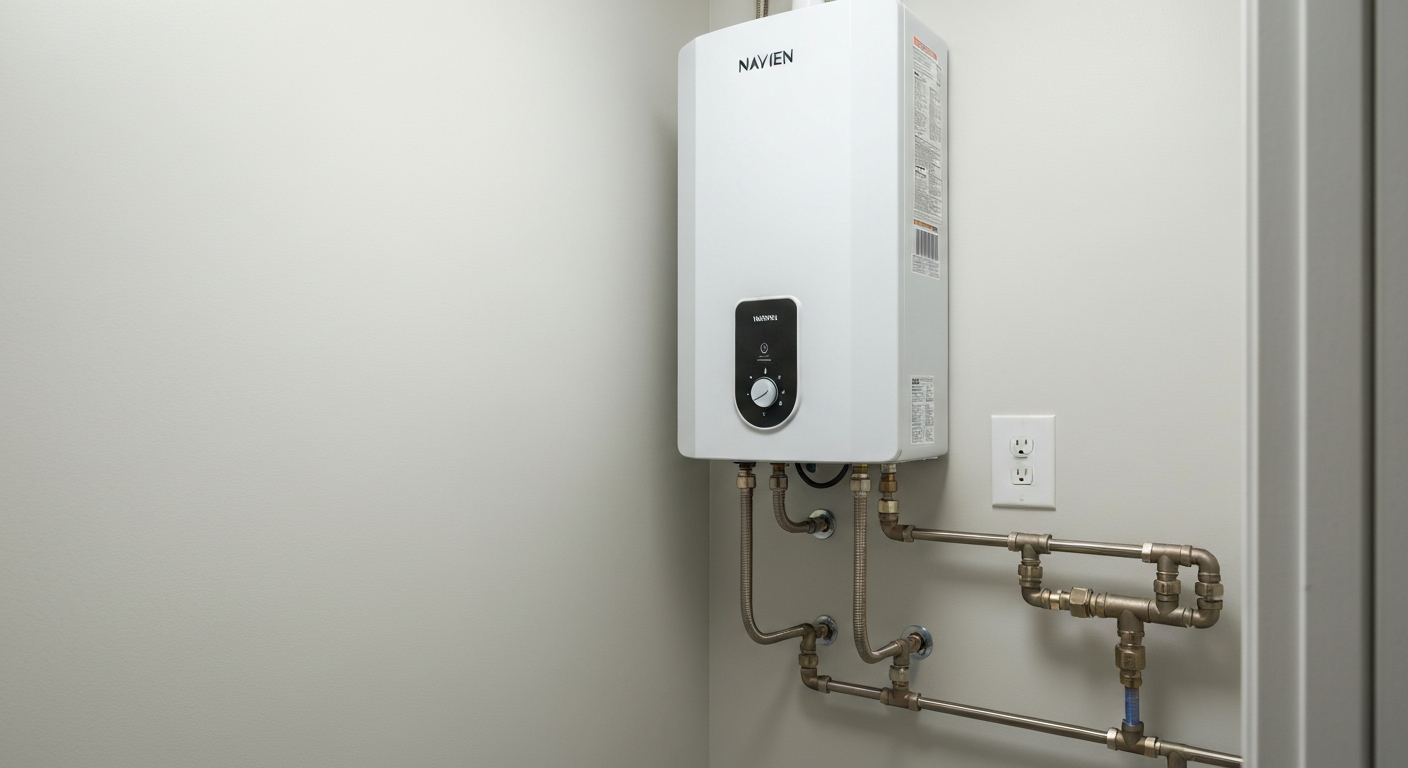
Most tank water heaters in the Philadelphia area fail between year 8 and year 12. The failure mode is almost never sudden — there are warning signs in the months before a tank lets go. Catching them early means a planned replacement on your schedule, not an emergency call on a Saturday morning with water spreading across your basement floor.
Here are the 6 signs that replacement is the right call.
Age is the single most reliable predictor of impending failure. Standard tank water heaters — 40 or 50 gallon natural gas units, which cover most Bucks County and Montgomery County homes — have a design life of 8–12 years. Some stretch to 15 with regular anode rod maintenance, but that's the exception, not the rule.
Tankless (on-demand) units last 15–20 years when descaled annually. Philadelphia-area water hardness averages 100–150 mg/L (moderately hard), which means mineral scale builds up in the heat exchanger over time. Annual descaling keeps them running. Neglect that and you cut 5+ years off the lifespan.
To find your unit's age: look at the serial number on the data plate on the side of the tank. Most manufacturers encode the manufacture year in the first four digits of the serial number. Call us if you need help reading it — we can figure it out in 30 seconds.
Discolored hot water from your taps points to corrosion inside the tank. Here's how it works: tanks have a sacrificial anode rod — a magnesium or aluminum rod that corrodes preferentially to protect the steel tank interior. When that rod is exhausted (usually around year 5–8), the tank itself starts corroding.
You can sometimes extend tank life by replacing the anode rod, but by the time you're seeing rust-colored water, the corrosion is usually well advanced and the tank is close to failure. Replacement is the reliable fix.
Important: If you have rusty water from both hot and cold taps, the issue may be your supply pipes (common in older homes in Germantown, Chestnut Hill, or Northeast Philadelphia with original galvanized plumbing) — not the water heater. Test by running only hot water from a fixture; if it's rusty and cold is clear, the tank is the problem.
A rumbling, popping, or banging sound when the burner fires is sediment. As hard water heats repeatedly in a tank, minerals precipitate out and form a layer on the tank bottom. The burner then heats water through that sediment layer, causing it to pop and rumble as steam bubbles form underneath.
Sediment buildup does two things: it forces the burner to run longer to heat the water (higher gas bills), and it accelerates the corrosion of the tank bottom. A tank making regular rumbling noises has typically lost 20–30% of its heating efficiency and is in the late stages of its service life.
If the tank is under 7 years old, a full flush by a technician can sometimes remove enough sediment to extend its life. Over 10 years old, the flush rarely justifies the cost.
Any visible moisture or pooling around the base of the tank is a replacement situation. Small leaks from the relief valve or supply connections can sometimes be repaired. A leak from the tank body cannot. Once the steel interior is corroded through, the tank must be replaced — there's no patch for a failing water heater tank.
If you find water around the unit, turn off the cold water supply valve at the top of the unit and call us. Don't wait to see if it gets worse. A failed tank can discharge 40–50 gallons quickly and cause significant water damage.
If your household's hot water usage hasn't changed but you're running cold faster, the unit's capacity is degrading. Common causes:
An element replacement on an electric unit under 8 years old costs $200–$400 and is worth doing. On a 12-year-old unit with sediment problems, replacement makes more sense.
A pilot light that goes out once in a blue moon is not a red flag. One that needs to be relit weekly, or a unit that cycles through multiple ignition attempts on every call for heat, is telling you something is failing. Common culprits:
A thermocouple replacement on a unit under 8 years old is a straightforward repair. On a 12-year-old unit, putting $400–$800 into a failing gas valve is rarely smart when a new Bradford White 40-gallon unit installs for $1,450–$1,800 all-in.
| Type | Installed Cost (Philadelphia Area) |
|---|---|
| 40-gallon natural gas tank (Bradford White) | $1,450 – $2,100 |
| 50-gallon natural gas tank (Bradford White) | $1,700 – $2,500 |
| 50-gallon electric tank | $1,150 – $1,800 |
| Tankless natural gas (Navien) | $3,200 – $5,800 |
| Tankless — with gas line or venting upgrade | $4,600 – $7,200 |
We install Bradford White for tank units and Navien for tankless systems. Both are manufactured with stronger commercial-grade components than big-box store brands and carry better warranty terms. Bradford White in particular is a US manufacturer with direct dealer distribution — no warehouse club supply chain.
Tank water heaters typically last 8–12 years. Tankless units last 15–20 years with proper maintenance (annual descaling). Philadelphia-area water is moderately hard, which can shorten tank life if the anode rod hasn't been serviced. Check the serial number on the unit — the first four digits usually encode the manufacture date.
Rusty or brown hot water almost always means corrosion inside the tank. The anode rod, which sacrificially corrodes to protect the tank, has worn out. Once the rod is gone, the steel tank itself starts corroding. This is not repairable — the unit needs to be replaced before it fails and floods your basement or utility room.
Tank water heater replacement in the Philadelphia area typically runs $1,450–$2,900 installed for a 40–50 gallon natural gas unit. Tankless (on-demand) replacement runs $3,200–$5,800 installed, depending on whether gas line or venting upgrades are needed. We install Bradford White tank units and Navien tankless systems.
If the unit is under 7 years old and the repair is under $500 (thermocouple, pilot assembly, thermostat), repair makes sense. If the unit is over 10 years old, or if the tank itself is leaking or corroded, replacement is the only option. A leaking tank cannot be repaired.
Tankless units cost roughly $1,950–$3,200 more upfront but last 5–8 years longer and use 20–30% less energy than a tank unit. For a household using 70+ gallons per day, the energy savings can be $200–$400/year. Payback on the cost premium runs 7–12 years, but you also avoid one replacement cycle over a 20-year horizon.
Published April 8, 2026 by McCorry Comfort Team. Serving Philadelphia, Montgomery County, Bucks County, and Delaware County since 2001.
📍 Serving Philadelphia, Montgomery County, Bucks County & surrounding areas. Available 24/7.
